

Types of Cherry Trees and Popular Cultivars
Cherry trees are among the most beautiful and versatile trees you can grow, admired for their spring blossom, summer foliage, and, in some cases, their fruit. Whether you’re looking for a striking ornamental display or a tree that provides delicious cherries, there’s a wide range of cultivars to choose from across the Prunus genus - though here at Barcham, our curated range focuses predominantly on high-performance ornamental varieties.
Ornamental vs. Fruiting Cherry Trees
Broadly speaking, cherry trees fall into two main groups: ornamental and fruiting.
- Ornamental cherry trees (also known as flowering cherries or cherry blossom trees) are prized for their spectacular blossom rather than their fruit. They’re often used in gardens, parks, and avenues to create seasonal interest.
- Fruiting cherry trees are grown for their edible cherries and are commonly divided into sweet and sour/tart types.
Sweet cherries are usually eaten fresh, while sour or tart cherries are more often used in cooking, baking, or preserves.
Both types belong to the genus Prunus, and many share similar growing needs:
- Well-drained soil. Drained soil lets excess water drain away quickly instead of staying waterlogged around the roots. Roots get moisture but also air (oxygen), which they need to stay healthy.
- Full sun. The tree should receive at least six hours of direct sunlight per day. Sunlight encourages strong, healthy growth and abundant flowering (essential for ornamental cherries). For fruiting cherries, good sun exposure helps ripen the fruit and improve its sweetness.
- Sheltered position. Strong or cold winds can damage delicate blossoms, which are particularly vulnerable in early spring. Cold, dry winds can also strip moisture from leaves and buds, stressing the tree. A sheltered spot (for example, near a wall, fence, or other trees) creates a microclimate that keeps the tree warmer and more stable, reducing the risk of frost damage and improving blossom retention. However, avoid planting too close as their vigorous root systems need adequate space to develop without causing damage or competition.
Popular Ornamental Cherry Tree Cultivars
Most ornamental cherry trees grown for their blossom rather than fruit belong to a few main species and hybrids within the Prunus genus. Among the most common are:
- Prunus serrulata – the Japanese flowering cherries, which include famous cultivars like ‘Kanzan’, ‘Tai Haku’, and ‘Shirotae’ (Mount Fuji).
- Prunus x yedoensis – known as the Yoshino cherry, a hybrid celebrated in Japan’s cherry blossom festivals.
- Prunus sargentii – or Sargent’s Cherry, valued for its vivid pink flowers and striking autumn colour.
These ornamental cherries are cherished for their spring blossom displays, attractive foliage, and graceful shapes, rather than for fruit production. Ornamental cherries are often grouped by their flower form, with trees producing either single flowers or double and semi-double blooms.
Single-Flowered Varieties (Graceful and Early)
Single-flowered cherries are prized for their elegant, simple form, often blooming earlier and allowing a clear view of the bark and structure.
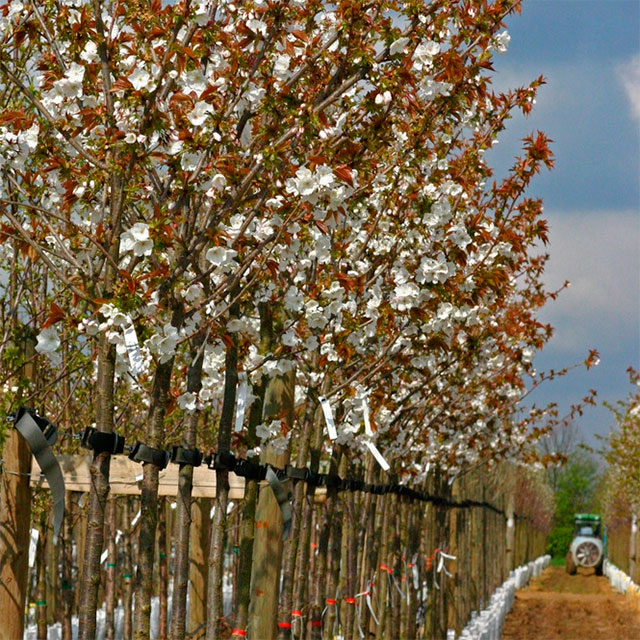
Prunus ‘Tai Haku’ (Great White Cherry)
In the spring, this ‘Tai Haku’ gives its greatest display; the large, single white flowers emerge profusely and contrast magnificently with its young, copper coloured foliage. In the autumn, this tree gives its second show with foliage turning yellow/orange before falling.
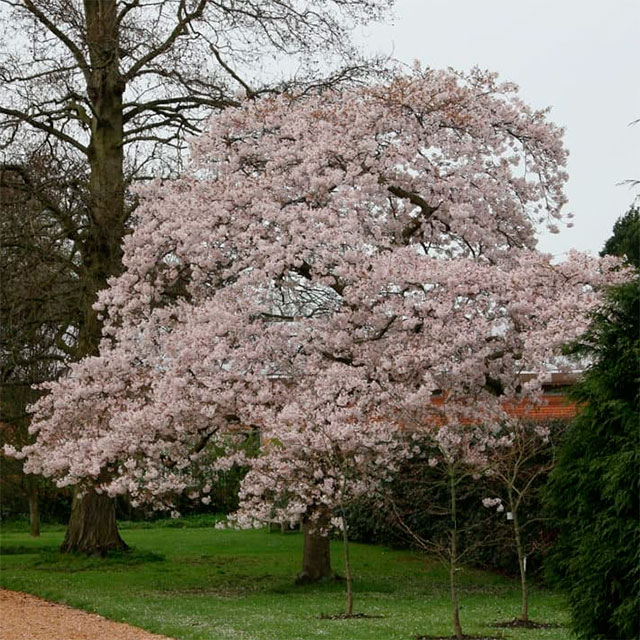
Prunus x yedoensis (Yoshino Cherry)
Famous for its role in Japan’s cherry blossom festivals, this elegant tree offers single, pale pink to white blooms and a soft, spreading canopy. The leaves emerge a coppery colour towards the end of the floral display; they are serrated on the margins and deep green in colour, turning to red-orange in autumn.
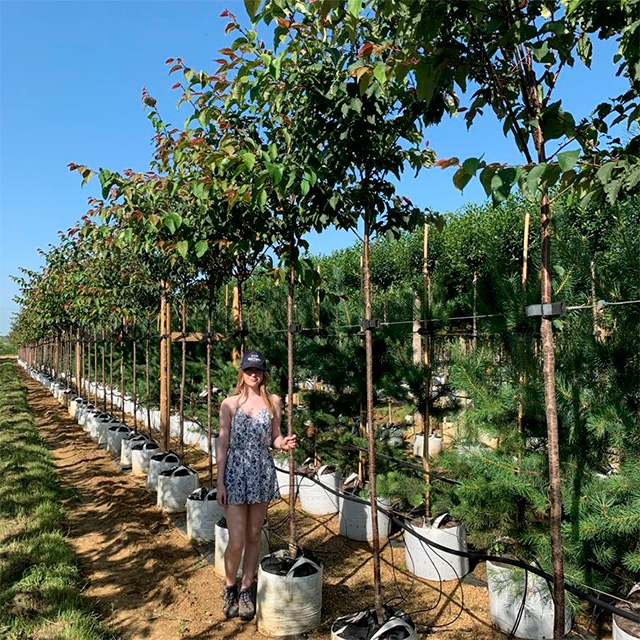
Prunus sargentii (Sargent’s Cherry)
One of the loveliest of flowering cherries, it bears abundant single pink flowers in March and April and is one of the first to take on its autumn tints of orange and crimson.
Double & Semi-Double Flowered Varieties (Showy and Long-Lasting)
These varieties feature densely packed petals, creating a “blousy” cloud effect that holds its spectacular display longer than single flowers.
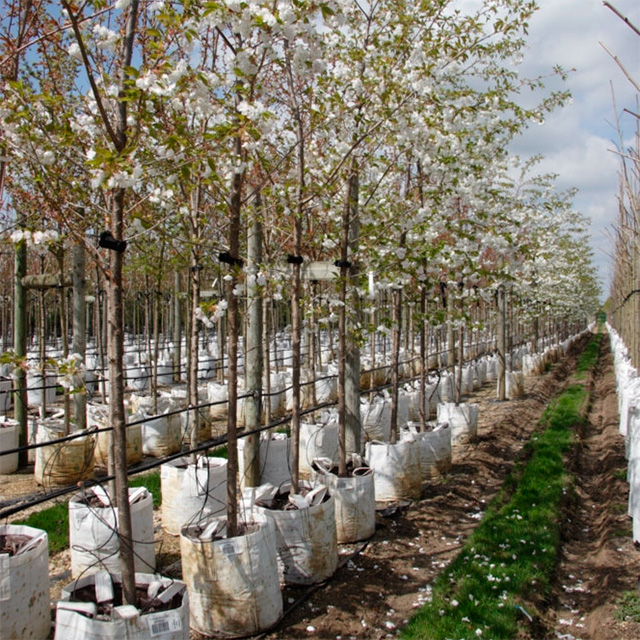
Prunus ‘Shirotae’ (Mount Fuji Cherry)
The foliage of the Mount Fuji Cherry tree appears first as a green fringe throughout the tree, swiftly followed by a combination of large single and semi-double pure white flowers. It is simply stunning when in flower. The flowers seem delicate yet are profuse and significant at the same time.
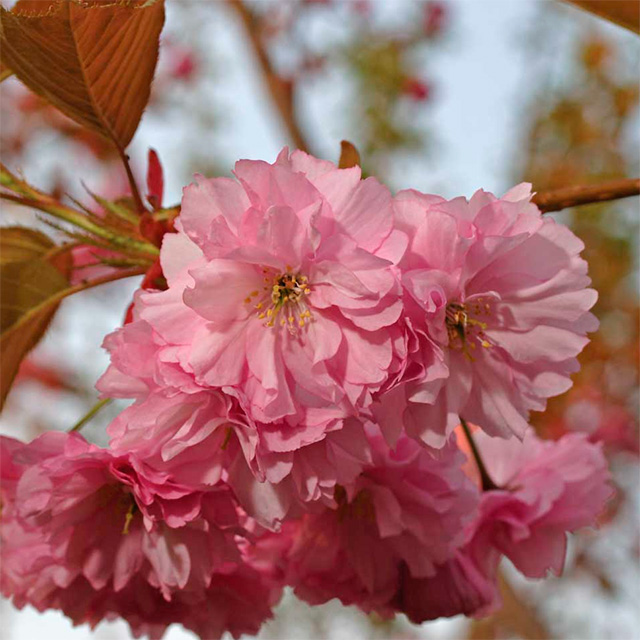
Prunus serrulata ‘Kanzan’
‘Kanzan’ cherry produces a profuse display of double, showy dark pink flowers in the spring. The foliage is a coppery red, reasonably large, and serrated on the margin. In autumn, the leaves turn to brilliant oranges and coppery reds.
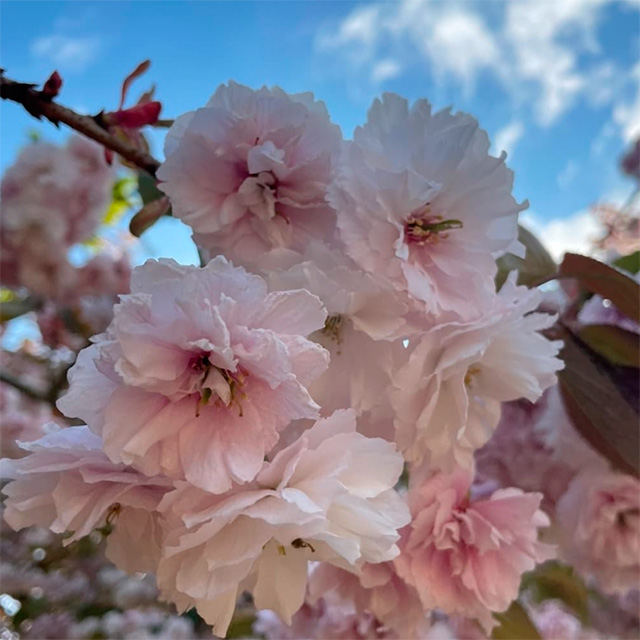
Prunus ‘Shirofugen’
Also known as Japanese Cherry ‘Shirofugen’, this tree is one of the last cherries to produce its show of beautiful double white flowers, which gradually turn pink.
Popular Fruiting Cherry Tree Types
At Barcham, we focus primarily on ornamental varieties rather than fruiting cultivars, but understanding the key cherry species helps gardeners choose the right tree for their landscape and growing conditions.
When we talk about fruiting cherry trees, nearly all the ones grown for edible cherries belong to two species:
- Prunus avium – sweet cherries
- Prunus cerasus – sour (or tart) cherries
Sweet Cherry Trees (Prunus avium)
These are the cherries you’ll find in summer fruit bowls – glossy, sweet, and perfect for eating fresh. They’ve been grafted and selected over centuries to produce larger, sweeter, and more consistent fruit.
Common sweet cherry cultivars include:
- ‘Kordia.’ Juicy black fruits are produced by late summer, and their tough skins make them durable enough to be left untouched by summer downpours. ‘Kordia’ is self-sterile, which means it needs a pollinator cherry tree nearby to produce fruits.
- ‘Stella.’ Probably the most famous self-fertile (does not need a pollinator) sweet cherry. Produces large, dark red fruit with excellent flavour. Compact growth and reliable cropping make it ideal for gardens.
- ‘Sunburst.’ Self-fertile, heavy cropper, with large, juicy, almost black cherries. Ripens in mid-season.
- ‘Sweetheart.’ Late-ripening, self-fertile variety that extends the cherry season. Firm, bright red fruit with a balanced sweetness.
- ‘Lapins.’ A Canadian variety producing large, crack-resistant fruit. Self-fertile and a good pollinator for others.
Note: While Prunus avium (Wild Cherry) is the species behind the above-listed cultivated sweet cherry tree cultivars, the tree itself is the native UK form rather than a fruiting cultivar. Its fruit is small and mainly enjoyed by birds, not grown for eating.
Sour Cherry Trees (Prunus cerasus)
Sour cherries are smaller and sharper in flavour (to the point of being tart), perfect for cooking and preserving. They’re often hardier (tougher and more resistant) and can cope better with cooler or more exposed locations.
Popular cultivars include:
- ‘Morello’ – the classic cooking cherry, excellent for pies and jams
- ‘North Star’ – compact and cold-tolerant, ideal for smaller gardens
Choosing the Right Cherry Tree for Your Space
When selecting a cherry tree, first make sure the planting spot has well-drained soil. If it doesn’t, it may be better to choose a different location or tree type.
Once the soil is suitable, consider these key factors:
- Purpose – Do you want blossom, fruit, or both?
- Size & crown – Some varieties stay compact, while others can grow quite large. At Barcham, we include the mature height of each tree in the Specifications section at the bottom of the page. Another important consideration is the shape of the crown. For example, a large, rounded crown might not be suitable for a smaller garden.
- Pollination – If you’re planting a fruiting cherry, check whether it is self-fertile (can fruit on its own) or if it needs a pollination partner nearby to produce cherries. Feel free to reach out if you have any doubts.
Caring for Cherry Trees
All cherry trees benefit from:
- Mulching annually. Create a weed-free circle about 1 metre around the base of the tree. Apply a 5cm layer of bark mulch, which helps retain soil moisture, suppresses weeds, and supports healthy soil life. Avoid chemical weed killers, as these can harm the tree.
- Regular watering during dry periods, particularly while young. Read our tips on watering newly planted trees.
- Light pruning after flowering to maintain shape and remove dead or crossing branches. Read more on how to prune fruit trees.
With the right care and selection, cherry trees can bring decades of beauty – and sometimes a crop of delicious fruit – to your garden.
Cherry Trees from Barcham
Our trees are container-grown for strong, healthy root systems and can be planted at any time of year. If you’re not sure which cherry tree is right for your setting, please don’t hesitate to contact our team for advice.
Frequently Asked Questions
The following are answers to the most frequently asked questions about cherry trees.
Do ornamental cherry trees produce fruit?
Most ornamental cherry trees can produce fruit, but the fruit is usually small, bitter, or not suitable for eating – nothing like the large, sweet cherries (Prunus avium) or sour cooking cherries (Prunus cerasus). In many ornamental varieties, the fruit is so minimal or insignificant that it often goes unnoticed. Birds may eat it, but humans generally don’t. Some cultivars are sterile hybrids (trees that result from crossing two different cherry types), which means they don’t produce edible fruit at all. This is especially true of double-flowering Japanese cherries.
How long to wait for the first crop when it comes to fruiting trees?
Because Barcham supplies semi-mature trees (from 10-12 cm girth upwards), your wait for the first fruit is significantly reduced. Most fruiting trees supplied will already be mature enough to crop immediately, or within the first one to two years after planting, provided they have a suitable pollinator nearby (if required). You can expect a reliable, consistent harvest from the start.
How long does a cherry tree take to grow? Is it a fast-growing tree?
Cherry trees are medium-rate growers, typically adding 1 to 2 feet (30 to 60 cm) of height per year. However, since you are starting with a substantial specimen (like our 10-12 cm girth trees), you are skipping the slow, early growth stages. Your Barcham tree is already well-established, providing an instant feature and reaching its mature height and spread much faster than a standard bare-root or smaller container plant.