

Pleached Trees and How to Utilise Them for Screening
Pleached trees create a narrow, elevated screen of foliage, making them ideal for adding privacy above fences and boundaries without sacrificing garden space.
What are pleached trees?
Pleaching traditionally involves tying in and interlacing young, flexible shoots along a supporting framework. This encourages neighbouring trees to grow together and eventually form a continuous screen.
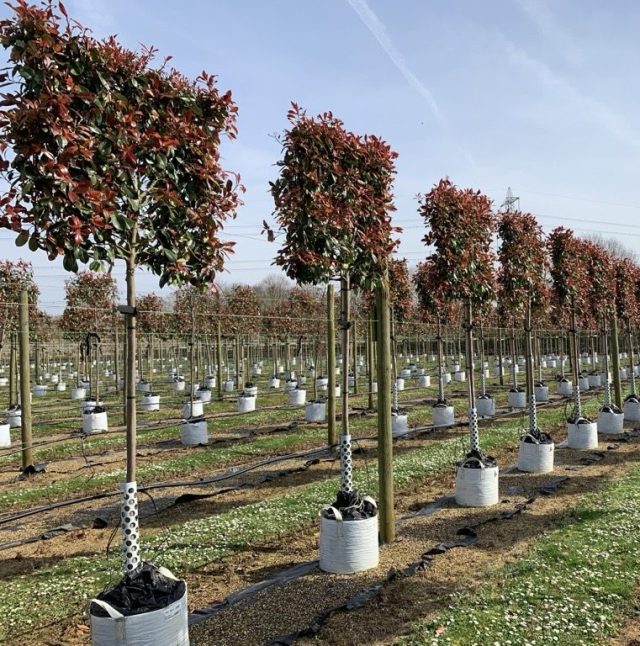
Here at Barcham Trees, our pleached trees are typically trained on bamboo or metal frames. We focus on producing pleached trees that sit above standard fence height for screening purposes, although lower stems can be pleached depending on the species. Please ask our sales team for more information.
How can pleached trees be used for screening?
Pleached trees are particularly useful in smaller spaces. Because they are trained onto flat frames, they create a narrow screen of foliage that takes up minimal space within the garden.
At Barcham Trees, many of our pleached trees are grown with a 1.8-metre clear stem supporting a bamboo frame approximately 1.2 metres wide and 1 metre tall.
This makes pleached trees particularly useful for:
- Screening neighbouring properties
- Increasing privacy above fences and walls
- Dividing different areas of a garden
- Adding height and structure to smaller gardens
- Creating formal avenues and boundaries
Trees available as pleached forms
A wide variety of trees can be trained as pleached specimens. Varieties grown by Barcham include:
- Carpinus betulus – Common Hornbeam
- Liquidambar styraciflua ‘Worplesdon’ – Sweet Gum
- Ilex x castaneifolia – Chestnut-leaved Holly
- Photinia x fraseri ‘Red Robin’
- Pyrus calleryana ‘Chanticleer’ – Ornamental Pear
- Malus spp. – Crab Apple
Different varieties offer different benefits, including flowers, autumn colour, berries and varying levels of winter screening. Where privacy is the main priority, our guide to the best trees for screening explores more options for creating cover above fences and boundaries.
Choosing between deciduous and evergreen pleached trees
Pleached trees can be grown from both deciduous and evergreen species, and the choice between them will affect how the screen performs throughout the year.
Our most popular pleached tree for screening is Hornbeam, which is deciduous. It provides dense screening during the growing season, along with autumn colour as the leaves turn yellow. Hornbeam may also retain a proportion of its dry leaves through winter, providing some continued screening, although this is not guaranteed.
Evergreen pleached trees, such as Chestnut-leaved Holly and Photinia ‘Red Robin’, retain their foliage year-round. This makes them a better option where consistent privacy or screening is required throughout the seasons.
The right choice will depend on your priorities, as well as the planting conditions and overall design of the space.
Planting pleached trees
For a continuous screen, pleached trees can be planted with approximately 50 cm between the edges of their frames. With suitable growing conditions and proper care, new growth should begin filling these gaps during the following growing seasons.
When deciding on the exact spacing, consider:
- The width of each frame
- The variety and vigour of the tree
- How quickly a solid screen is required
- The amount of ongoing pruning and maintenance you are prepared to undertake
Like other newly planted trees, pleached specimens normally require suitable staking and support while their roots establish. The bamboo framework trains the crown, but it does not replace the support needed to stabilise the rootball and stem after planting.
Please refer to our tree planting guide for full planting and aftercare instructions.
Maintaining pleached trees
Pleached trees need regular pruning to preserve their flat shape and prevent the crown from developing into the tree’s natural form.
Once established, they will generally need pruning at least once a year. Growth extending beyond the front, back or edges of the frame should be cut back, while suitable new shoots can be tied into the framework to fill any remaining gaps.
Late winter or early spring is suitable for many pleached trees, although the best pruning period can vary by species. Additional light trimming during the growing season may also be useful where a particularly neat, formal appearance is required.
Our guide to how to prune screening trees provides more detailed advice for Privet, Photinia, Laurel and Portuguese Laurel.
Without regular pruning, branches will gradually grow beyond the framework and the tree will begin to develop a larger, more natural crown.