

Photo gallery


-
Zoom image 1

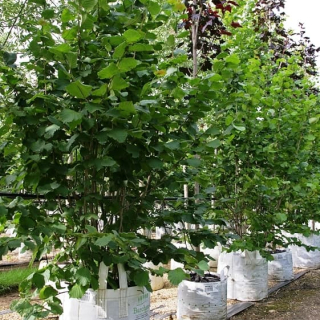
Multi-stem Corylus avellana on the Barcham Trees nursery -
Zoom image 2

Multi-stem Corylus avellana catkins -
Zoom image 3

Small-sized Corylus avellana multi stem on the Barcham Trees nursery -
Zoom image 4

Small -
Zoom image 5

Carbon rating -
Zoom image 6

Carbon rating
Common Hazel, Cobnut, Filbert
Corylus avellana multi stemAbout this product
PLEASE NOTE: The 2.0-2.5m are supplied in 100L containers.
Corylus avellana, also known as Common Hazel, is native to the UK. It has long been cultivated for its hazelnut production. Additionally, it is grown and regularly coppiced to produce poles for naturalized fencing and for wattle and daub building.
The Common Hazel has bright green, fairly rounded foliage which appears in spring after the striking display of long yellow catkins or “lambs tails” in Jan/Feb time. The hazelnuts are produced in abundance throughout the summer, finally ready for harvesting in the autumn.
Corylus avellana is a sturdy, traditional hedging plant that is widely used throughout the UK on field boundaries. It also works well for underplanting in a woodland/densely planted area, as it can tolerate shade.
At Barcham, we supply the Common Hazel as a multi-stem, coppiced specimen which can be used to infill a hedge or indeed create one! In 2007, our neighbour planted an Instant hedge of Hazel, which is now doing extremely well; if you come and visit Barcham, be sure not to miss it!
Whether planted as a hedge or an individual specimen, Corylus avellana benefits from routine coppicing to just 5-10 cm above the ground, on a five-year cycle. This is best done after the catkin display in Feb/March, and whilst you will sacrifice the nut crop for that season, coppicing will invigorate growth. The tree will grow back quickly and be more vibrant and full in response. It is considered a fast-growing shrub, especially when coppiced regularly.
A hardy contender, this tree will thrive in most soil conditions. It is well-suited to growing in large containers, although regular pruning is essential to maintain its shape and vigour when grown in pots.
Buds are rounded and slightly hairy, forming in pairs along the twigs and helping with winter identification.
The bark is smooth and grey-brown with occasional horizontal markings, adding quiet textural interest in winter once the leaves have fallen.
It can be planted for a myriad of purposes, ranging from in gardens for hazelnut production to on the boundary of farmland for hedging; it is a truly versatile native treasure. The genus Corylus also includes other ornamental and edible varieties, such as Contorta and Zellernuss, but avellana remains the most widely planted for native and productive schemes.
Mature Height: 3-7m
Specifications
- Common names
- Common Hazel, Cobnut, Filbert
- Height of tree
- 3-7m
- Soil type
- Well drained, Will tolerate most soil types
- Shape
- Multi-stemmed, Hedging
- Foliage Colour
- Green
- Fruit and Nut
- Nut
- Information Flags
- Native
- Looks good in
- Summer, Spring
- Location
- Garden, Parkland
- Genus
- Corylus